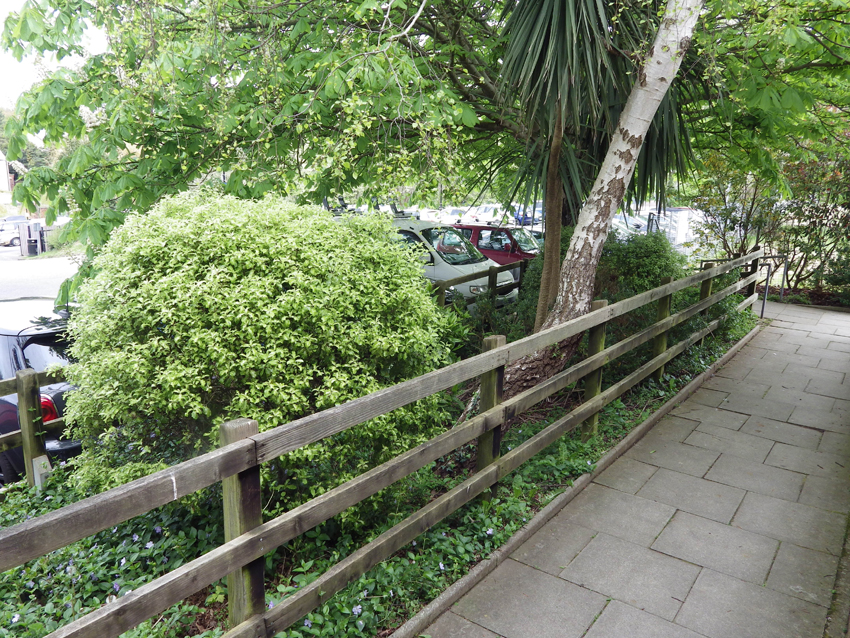
Many thanks to Mark for the editorial and photographs this week.
Isle of Wight Green Gym - Official Blog.
Blog Archive
IoW GG links
To look at the Isle of Wight Green Gym web page (contains details of sessions etc) please use the following link :- www.iwgreengym.org.uk.
The link to Twitter is https://twitter.com/iwgreengym
We now have a "Local Giving" webpage. If you would like to support the group's activities, please take a look by clicking this link. Many thanks!
Friday, May 17, 2013
Wed 15th May 2013 - Castle Copse, East Cowes.
Many thanks to Mark for the editorial and photographs this week.
Wednesday, May 8, 2013
Wed 8th May 2013 - Corfe Camp, Porchfield.
A return visit this week to Corfe Camp near Porchfield, and luckily it had not started raining - yet! Tasks included a fair amount of ditching work, as many of them have got clogged up with leaves and branches over the winter, and keeping them clear improves the drainage for the camping sites; there was also a fair amount of pruning in several places around the site, and ensuring the boundary areas of dead wood and cut branches were tidy. We also went back to those areas we cleared of trees and bramble last time, to ensure that there were no trip hazards by cutting any tree stumps level with the ground
Carrie’s Nature Lesson.
A nature lesson with a difference this week, the subject is something alive! This beautiful juvenile mute swan (Cynus olor) was very happy to have his picture taken at Newtown Creek. These are one of our largest waterfowl, can be up to 155cm long with a wingspan of 200-240cm, and weigh as much as 15kg. The adult has an all white plumage, sometimes with a yellowish tone, black feet and an orange/red beak with a black knob at the root, this being noticeably larger in the male. The young are born with a grey, downy plumage that is gradually replaced by brown feathers, that slowly turn white in the first 1-1½ years, and their beaks are grey. The mute swan is usually silent, but it can make a hissing sound if it feels threatened, although they can be quite tolerant of human presence (the subject of the picture was only a couple of feet away).
They live near water such as lakes, moors and shallow waters feeding exclusively on vegetation found in the water or on the banks. Each couple requires a fairly large territory that it defends from other swans and sometimes also from other aquatic birds. Breeding starts at the age of three, and in late spring the mute swan makes a huge nest where 3-7 eggs are laid, hatching out after 35 days. The mute swan is very protective of its nest and offspring and can be very aggressive towards intruders. It is capable of delivering a strong blow with its wings, but rarely bites.
Many thanks to Carrie for the editorial, photographs and nature lesson.
Wed 1st May 2013 - Red Squirrel Dell, Ryde (Part 1)
We returned to the Squirrel Dell at Ryde, on an absolutely glorious sunny
day, with the usual list of tasks to tackle. The guys from St Georges did a
sterling job weeding a raised bed at the edge of the site, ready for
planting. Other tasks were the cutting back of laurel and snowberry and
putting up a section of wire fence to make the site even more secure. The
final task was to continue creating scrapes around the site, which it is
hoped will attract lots of wildlife. As you can see from the picture this
scrape quickly filled with water, and was soon visited by a couple of
solitary bees and also a robin, so fingers crossed for lots more fascinating
creatures!
Carrie's Nature Lesson.
This week's find were some Spanish bluebells (Hyacinthoides Hispanica), a
spring-flowering bulbous perennial native to the Iberian Peninsula. It is
distinguished from the common bluebell by its paler, large blue flowers
(they can also be white or pink), more erect flower stem, broader leaves,
blue anthers (the common bluebell has creamy-white ones) and little or no
scent. It was introduced into the UK where it has become an invasive
species, and hybridises freely with our native bluebells - this has caused
our common bluebell to be viewed as a threatened species.
Many thanks to Carrie for the above photographs, editorial and nature lesson.
Saturday, May 4, 2013
Wed 1st May 2013 - Red Squirrel Dell, Ryde. (Part 2)
Ryde was the destination this week for a return to the Squirrel Dell where we set to work creating more scrapes for wildlife habitat, weeding the raised bed, installing a perimeter fence and removing some non-native garden-escapees which had made there way there from neighbouring gardens. All in all, along with litter-picking the suite we made a difference again to one of the Islands little reserves.
Many thanks to Helen for the photographs and Mark for the editorial this week.
Subscribe to:
Posts (Atom)